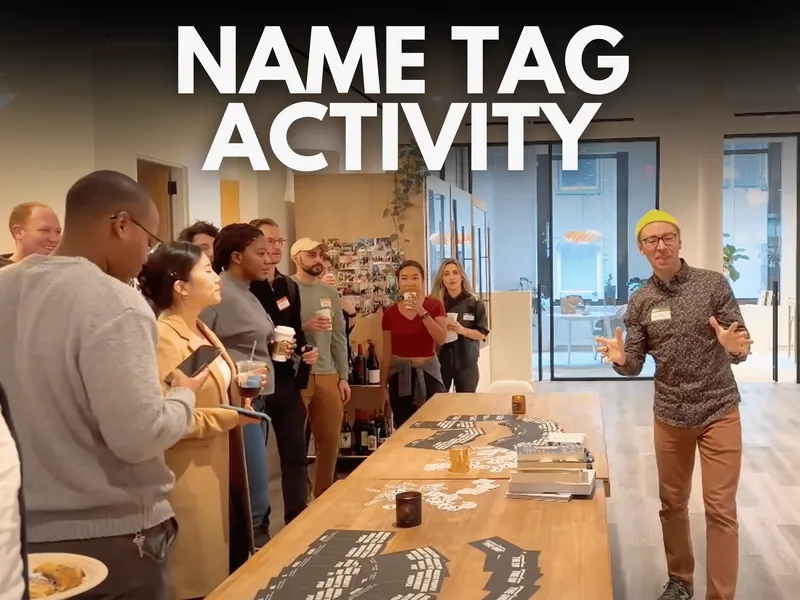
I ask the same handful of questions at every party I host.
Not because I've run out of ideas. Because the question you ask has one job, and most hosts pick one that quietly fails at it. A good party question gets people talking. A bad one makes them freeze while they try to sound interesting.
Here's the system I use, and the questions that go with each stage.
Green, yellow, red
The way I think about these questions is like green, yellow, red.
A green level question is for when there's no rapport built up in the group. People are a little bit awkward. They just need a softball question to get talking.
Yellow and red questions are more advanced. They come later in the event, once people have warmed up socially.
That's the whole system. Match the question to how warm the room is, not to how clever the question sounds.
Pro tip: I don't call these icebreakers any more. I say rounds of intros. The word icebreaker gets such a knee jerk negative reaction these days, especially in a personal setting.
Green: the questions you open with
Ask these in the first round, about 30 minutes in.
My go-to is breakfast. Say your name, say what you do for work or what you're working on, and share one thing you like to have for breakfast.
I like the breakfast question because it shows a little bit about somebody's personality. It's easy to answer. It doesn't cause people to lock up.
You might read that and think, what are we, in fifth grade? That is such a simple, childish intro. But I've tried this thousands of times with various groups, and it tends to work. The purpose isn't really to learn somebody's favorite breakfast. It's to get them talking and to show a little personality.
Other green questions I use:
- What's one thing you like to have for breakfast?
- What are you working on right now?
- What brought you here tonight?
- What's something you're looking forward to this month?
The question I never ask
"What's your favorite book?"
That seems like a good icebreaker. It isn't.
It takes a lot of thought. I can't name my absolute favorite book right away. I could name a few books that I like, but picking my exact favorite is a difficult decision. I'd obsess about picking the best possible book to make me sound smart or interesting.
It's definitive, it's subjective, and there's a little bit of judgment that might come from people. It makes people lock up.
The fix is one word. Ask "what's one of your favorite books?" or "what's one good book you've read this year?" That doesn't make it definitive, so it doesn't invite judgment.
Same problem with "what's your favorite movie?" and "what's the worst first date you ever went on?" Those are brain teasers, not openers.
Yellow: the middle of the party
By now people have talked to a few strangers. You can ask for a bit more.
- What's one of your favorite books, or one good book you've read this year?
- What's something you changed your mind about recently?
- What's a project you'd work on if you had a free month?
- How do you know the host?
That last one sounds boring. It works, because everybody in the room can answer it and it hands people a reason to talk to each other.
Grab the free 2-page party checklist.
Red: the value additive question
This is my favorite round, and I save it for the end.
A value additive question is one where everybody's answer adds value to the rest of the room. My two go-tos:
What's a great piece of media you've consumed recently? That could be a podcast, a video on YouTube, a documentary, a book, a TV show you binged. Everybody leaves with a list.
What's one of your favorite or secret spots in this city? It could be a dog park, or a biking path, a park you like, a small business you want to support, a really cool cafe, a museum that's open late. What's just a cool little city hack?
Here's what happens when you close with one of these. People leave thinking they met cool people and got a bunch of new ideas. You've immediately raised the bar for what a casual social meetup is, and you're seen as a good host.
One logistics note. Tell people the question about five minutes before you run that round, so they have a second to think.
Why ask questions at all
I run these rounds for three reasons, and only the first is obvious.
They create new conversations. That's the one everybody expects.
They also end conversations. Most people are good at starting a conversation and bad at leaving one. They stay in them much too long. When you lead a round of intros, it serves as a breaking point. People break, and then they reform later with somebody new.
And they give the room a roll call. Everybody gets to hear who's there, so you leave knowing who you wanted to talk to instead of finding out at the door that the person by the window did the exact thing you're working on.
How to actually run the round
Make the announcement about 30 minutes in, once most people have arrived.
Tell them why first. Something like: hey everybody, there's so many interesting people here and I want you all to meet each other. Then give the question, and give an example by answering it yourself first.
If the group is bigger than about a dozen, split into small groups of three or four for the first round, then circle up as a whole group later.
For the full mechanics, I wrote up how to run icebreakers separately. Put name tags on everyone before you start, or half the round is wasted on people forgetting names.
FAQ
What's a good party question for a group that doesn't know each other?
A green one. Name, what you do or what you're working on, and one thing you like to have for breakfast. It's easy, it's fast, and it doesn't make anybody lock up.
How many rounds of questions should I do?
Two or three. One green round early, and a value additive round near the end. A middle round only if the party is running long.
What makes a party question bad?
Anything definitive and subjective. "Favorite" questions invite judgment and make people freeze while they search for an impressive answer. Swap "your favorite" for "one of your favorite" and most bad questions become fine.
Isn't this too structured for a party?
People think that going in. My friend Zack Ware puts it well: it seems awkward and overly structured, and then you leave having talked to eight new people with two coffees on the calendar.
Try one this week
Pick one green question and one value additive question. That's a whole party's worth of structure.
If you want the topics rather than the questions, I keep a list of party conversation topics. And if you want people to arrive already knowing who's in the room, send guest bios beforehand.