I think most networking events are terrible.
They feel transactional. Nobody knows who's in the room, so you end up standing near the bar hoping you bump into someone interesting. I once paid $8,000 to attend a conference like that. There was no facilitated way to know who was there. I was frustrated, and I'd paid a lot of money to feel that way.
So I stopped attending bad networking events. I started hosting my own instead.
Big relationships always start at the acquaintance level. That's the whole thesis of my book, and it's why I built my last company, Museum Hack, on a network of people I met by hosting, not by attending somebody else's mixer.
In this article, you'll learn:
- How many people to invite so the room actually has energy
- The best nights to host, and the ones to avoid completely
- Exactly what to do in the awkward first 15 minutes
- How to run introductions that don't feel like a corporate retreat
- How to end the event on time without feeling rude
- A before-and-after checklist so nothing falls through the cracks
Stop Going. Start Hosting.
Here's the problem with most networking events. Nobody actually runs the room. You show up and you're stuck talking to whoever happens to be standing next to you.
Hosting flips that. You control the guest list, the format, and who meets who.
I love the research on the strength of weak ties. A sociologist named Mark Granovetter studied this and found that acquaintances, not close friends, are usually the ones who open new doors for you. A casual work contact is often more likely to hand you a job lead than your best friend is.
I believe you have to give before you can ask.
"I believe that to build relationships, you have to give before you can ask, and the fact that you're giving them drinks and snacks when they come up to your home, that's very nice."
A hosted event is value first. You give people a good night and real introductions. If you ever need something, you've already earned it.
"I launched that last business Museum Hack on the back of this network of acquaintances and loose connections and weak ties I'm talking about."
That's the reason I tell every new host to stop treating networking as something you attend and start treating it as something you run.
How Many People to Invite
The magic number is 15 to 20 people.
Anything less than 15 and the room doesn't have enough energy. You want a guest to walk in and think, "I'm not going to be able to talk to everybody here." That feeling is a good thing.
Fewer than eight and you have to babysit every conversation yourself. Above 15, conversations naturally break off and reform without you. More than 22 and introductions take too long, and you lose the small-group energy that makes these events work.
If you're new to hosting, invite more people than you need. In a big city, expect maybe half the people you invite to actually show up.
Pick a Day That Isn't Competing With Anything Else
Host on a Monday, Tuesday, or Wednesday night. Never Friday or Saturday.
Friday and Saturday are socially competitive. People already have plans, so you get bumped. A Tuesday or Wednesday evening is an easy yes because nobody else is asking for that slot.
Set a hard two-hour limit. Not two and a half. Two.
"One of the biggest mistakes people make is not setting an end time to their events. That causes slippage in what time people show up. It causes an extended awkward zone."
The awkward zone is real. It's that stretch at the start when only a couple of people have arrived and nobody quite knows what to do. A two-hour, clearly-timed event compresses that window down to 10 or 20 minutes, instead of the 30 to 90 minutes it usually takes to build momentum without one.
Give Guests Name Tags
I know this sounds like the least professional idea in a networking article. Do it anyway.
"The name tags really serve as a visual unifier for the group, that it's almost like a sports jersey. When you have a name tag, it shows that we're all on the same team. Not everyone here knows each other, and this is not a party of cliques. We are all equal."
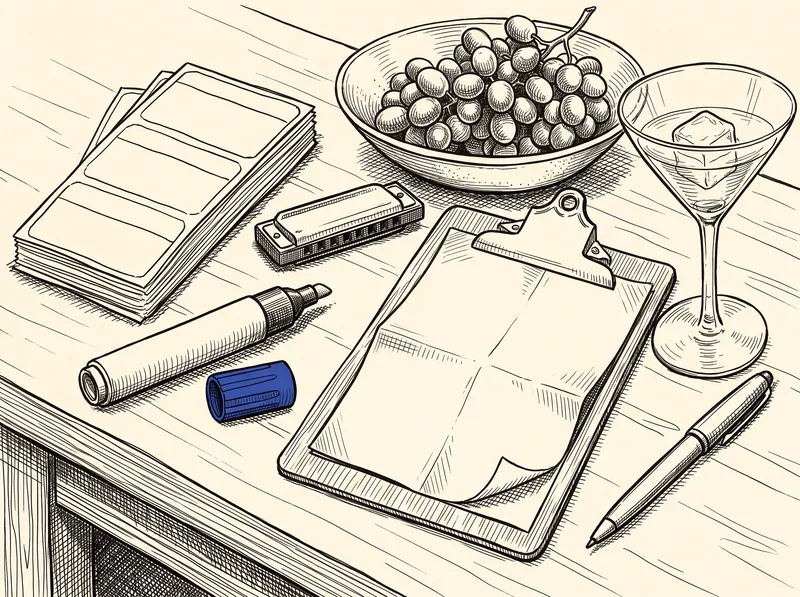
Write the name tag yourself as each guest arrives. Don't let people write their own.
"I think you should write the name tag when your guest come in, it gives you a way to welcome everybody, to sort of establish yourself as the party leader."
It gives you a one-on-one moment with every person who walks in.
"Alex." "Alex, A-L-E-X. Here's your name tag, Alex. Go over to the bar to see John, he'll help you find a drink, but thank you so much for coming today."
First names only, in big block letters. That's it. It removes the anxiety of forgetting somebody's name ten minutes after you met them, which happens to almost everyone at a networking event.
Get Through the Awkward Zone
Every event has an awkward zone. Even after hundreds of parties, mine still does.
Ask a couple of people from your core group to arrive 10 or 15 minutes early. Friendly faces make the room feel warmer before it fills up.
The first thing an early arrival asks is always the same question. "How can I help?" Have an answer ready.
"By having a ready set of tasks that you can ask people to help with, it reduces your burden as the host, it involves people to make them feel like they're on your team, and it just makes your party run."
Put someone in charge of the bar. Put someone on coat check. Put someone on photos, since you'll be too busy to take any yourself. A small job turns a bystander into a co-host.
Pro tip: Don't ask people to run the bar if they seem uneasy about it. Just say, "No problem, thanks so much. Just hang out over here and make yourself comfortable." Not every guest wants a job, and that's fine.
Run Rounds of Introductions, Not "Icebreakers"
The word "icebreaker" makes people cringe, especially at anything labeled a networking event. So don't call it that.
"I tend to use the phrase 'icebreakers' less, especially in America where that phrase has a little bit of a cringey connotation. Instead, I just say, 'Hey, we're going to do a few rounds of introductions.'"
Start with an easy question. Not "tell us a fun fact" and not "two truths and a lie." Those are bad icebreakers, and everyone secretly hates them.
"I hate though, 'Say a fun fact about yourself,' or, 'Two truths and a lie.' I think about icebreakers as green, yellow, red level of intensity or vulnerability, and many people will start with the red level, which is totally wrong."
A green-level question works because it's low stakes and easy to answer. What's one of your favorite breakfasts is a genuinely good opener. It sounds silly, but it works every time.
The host always goes first.
"I hate when people do this: 'Okay, everybody, we're gonna do a round of icebreakers. And Jeremy, you go first,' and they just point to some random person and this random person has to go first."
Model it yourself, then ask the person next to you if you can go to them next. Nobody gets put on the spot.
For your last round, ask something value-additive. What's a great piece of media you've consumed recently works well, because everybody leaves with a recommendation instead of just a name.
If your group is bigger, break into clusters of three to five people instead of one big circle. It's faster, lower stakes, and easier before anyone's warmed up.
Read a full rundown of formats and questions in my guide to icebreakers for adults, and if you want name tag ideas that go beyond first-name-only, check out name tag games.
Grab the free 2-page party checklist.
End on Time, With Authority
People remember how a night finished more than how it started.
Announce last call 15 minutes before the scheduled end time.
"Fifteen minutes before it's scheduled to end, I turn down the music, I say, 'Hey, everybody, thanks so much for coming tonight, we've met so many great people. The party's scheduled to end in fifteen minutes, so this is just a little reminder to grab a refill.'"
When the clock hits your actual end time, turn the lights up and thank everyone. Then start cleaning.
"I turn all the lights on, and then I just start to clean up. I start to rearrange things from the kitchen, the snacks table. And people start to notice, right, that like, okay, the party's winding down, they start to say their goodbyes."
Give people the permission to leave. Most guests are relieved to have a clear exit instead of guessing when it's polite to go.
Your Networking Event Checklist: Before and After
Before the Event
Invite people one at a time, never in a group text or a mass invite. Ask, "Can I send you the info?" before you actually send it.
Get five yeses from your core group first. Text them something like, "I'm thinking of hosting an event on Tuesday night. If I do it, would you come?"
Send three reminder messages: one about a week out, one three or four days out, and one the morning of the event. Nobody has ever complained about too many reminders.
After the Event
You have about 16 hours to follow up before the connection goes cold.
"I really only have about 16 hours after your party ends to try to create and deepen that next connection."
Send a thank you the next morning with the group photo you took about 30 minutes before the end. If you want to deepen a specific connection, ask for a coffee or a call in that same message, not a week later.
Put your next event on the calendar before you go to sleep, even if it's a month or two out.
The Real Value Is Skipping the Ask
If you meet somebody interesting at your own event, don't ask them to grab coffee later. Invite them to your next one instead.
"It is so easy to say to somebody, 'Hey, I'm hosting a little happy hour in a month. Can I send you the info when I do it?' That is such an easier ask than, 'Oh, I'd love to meet up and pick your brain,' or, 'We should get coffee sometime.'"
"No one is ever mad when you invite them to something."
That's the real networking hack. You're not chasing people down for their time. You're giving them a reason to want to spend it with you.
If This Is a Work or Company Event
Everything above works for a company happy hour too, and the name tags matter more, not less, when half the room works in a different department and has never spoken.
For a version built specifically for coworkers, see my breakdown of the company happy hour format. If mornings work better than evenings for your group, breakfast networking runs on the same formula with a different clock.
For the full planning timeline, from picking a date to building your guest list, my guide to planning a networking event walks through the whole runway.
Frequently Asked Questions
What is a networking event?
A networking event is any gathering built around meeting new people rather than one specific activity. A cocktail party, a happy hour, and a breakfast meetup all count. The best ones are small, have a clear end time, and give guests a structured way to meet each other instead of leaving it to chance.
What should I do before and after a networking event?
Before: invite people one at a time, get five yeses from your core group, and send three reminders (a week out, a few days out, morning of). After: follow up within 16 hours, send the group photo, and put your next date on the calendar before the momentum fades.
How many people should I invite to a networking event?
Aim for 15 to 20 attendees. That's enough for real energy without unmanageable logistics. Invite more than that number, since not everyone who says yes will show up.
What do you actually do at a networking event once people arrive?
Write name tags yourself as guests come in. Give early arrivals a small job like coat check or drinks. Run a short round of introductions with an easy opening question, then let conversations form on their own.
Can I host a networking event virtually?
Yes, but shrink the format. Keep the group small, use name displays instead of physical name tags, and run a quick round of introductions right at the start so people know who's in the room. A firm end time matters even more online, where a call can drag on without one.
What are some good networking event ideas beyond a plain happy hour?
A breakfast networking event works well if evenings are hard for your group. A themed round, like everyone sharing their favorite recent purchase under $100, gives a plain happy hour a reason to feel different. But the format matters more than the theme. Name tags, 15 to 20 guests, and a hard end time make almost any idea work.
Conclusion
Stop attending networking events that leave you standing near the bar hoping something happens.
Host your own. Fifteen to twenty guests, a Tuesday or Wednesday night, two hours, name tags at the door, and a clear end time. That's the whole formula.
Key takeaways:
- Most networking events fail because nobody is actually running the room
- 15 to 20 guests is the sweet spot for real energy without chaos
- Host on Monday, Tuesday, or Wednesday, and cap it at two hours
- Write name tags yourself as guests arrive, first names only
- Give early arrivals a small job to get through the awkward zone
- Call it a "round of introductions," not an icebreaker
- End on time with a 15-minute warning, then turn up the lights
- Follow up within 16 hours, before the connection goes cold
Your next steps:
- Pick a Tuesday or Wednesday three weeks out and text five people from your core group tonight
- Read The 2-Hour Cocktail Party for the full step-by-step system
- Use Mixily to send invites and collect RSVPs for your first event