A mixer event is a gathering built to get people who don't know each other talking to each other.
That's the whole definition. A mixer isn't a dinner, a conference session, or a party for your friend group. The point is the mixing. Guests come for the people, and the host designs the room so the right conversations actually happen.
Most mixers are social or professional. You'll hear "networking mixer" for the work version and "social mixer" for the version where nobody is trying to get hired. I'll cover both, because the format that works is almost the same.
What a mixer event is
A mixer is an event where the main activity is meeting new people. Everything else (the venue, the drinks, the snacks) is just support for that.
You'll see mixers at coworking spaces, chambers of commerce, alumni groups, neighborhood associations, and companies hosting customers. You'll also see them in someone's living room. The size and the budget change. The purpose doesn't.
If your mixer is for singles, the rules are different enough that I wrote a separate guide on hosting a speed dating event. This article is about networking and social mixers.
Why most mixers don't work
Most mixers fail because nobody runs the room. People arrive, grab a drink, and stand near the people they already know.
I think the same about networking events in general. They tend to be transactional. Everyone wants to know what they can get out of you. They attract people who mostly want to sell something and hand out business cards. And there's little structure, with no intention behind starting new conversations.
That last part is the problem. Little structure and no intentionality. A good mixer fixes both.
What makes a good mixer
A good mixer has four things. The right mix of people, the right size, a little structure, and a clear end time.
1. A mix of people, not a type
The word "mixer" tells you what to do. Mix people who wouldn't normally meet.
I like to invite people from different lines of work, plus a few good conversationalists from outside the industry. A really boring event for me is all work people. It just feels like work. So I recommend diversity at your parties. I don't mean ethnic or racial diversity. I mean occupational diversity.
An all-work room feels like it has an ulterior motive. A mixed room feels like a good night out.
2. Enough people, but not too many
Aim for 15 to 22 guests. Fewer than 15 and you end up babysitting the room. Sometimes it collapses into one circle. More than 22 and the introductions drag.
At 15, a guest looks around and thinks there are too many people to talk to. That's the feeling you want.
3. A little structure
Structure is what separates a mixer from a crowd in a room. You don't need much. You need name tags and one round of introductions. I'll cover both below.
4. A start time and an end time
Put both on the invitation. A two-hour window shrinks the awkward period when everyone hedges on when to arrive. It also makes the event an easier yes. People know it isn't an all-night commitment.
How to host a mixer, step by step
Here's the sequence I'd follow. It's built for a standing room of 15 to 22 people and about two hours.
Step 1: Don't call it a networking event
For a work mixer, I'd still avoid putting "networking event" in the invite. A matchmaker once told me the secret to a successful singles event is to never call it a singles event, because it puts too much pressure on every interaction. I think the same is true here.
Nobody wants to go to a networking event. I don't want mine to feel business network-y either. I host at my home so it doesn't feel like some scammy thing. But that's kind of what it is. It's a networking event of your neighbors.
Call it a happy hour, a meetup, or a mixer. Then say what it is: a chance to meet interesting people, no agenda.
Step 2: Take the chairs away
Standing guests can walk up to someone and walk away again. Seated guests get stuck with whoever is on their left and right. Sitting down is almost the kryptonite to a good event where the purpose is to make new friends.
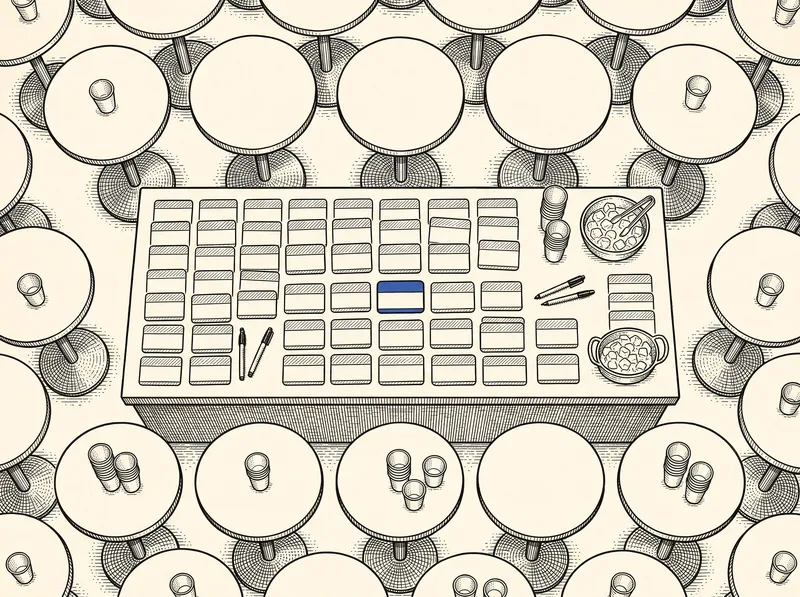
Clear the floor. Add a few high tables or ledges for drinks and plates.
Step 3: Put name tags on everyone
Use first names only, written in big block letters. I write them by hand as each person arrives, because it gives me a reason to welcome them and point them toward someone else.
Name tags work like a sports jersey. They tell a mixed room that this isn't a party of cliques. It's an okay place to walk up and say hi. For the full why, see my guide to name tags.
If your guests are senior or well-known and you think they'll roll their eyes, keep the tags and add a rule. I suggest this:
Hey, name tags, first names only. And for the first 20 minutes you're not allowed to talk about business or work.
That 20 minutes gets people connecting as people before anyone reaches for a business card.
Step 4: Tell them why
Before you run anything, explain the reason. People resist structure when it feels arbitrary. When you give them the why, most of the resistance goes away.
Something like: "I'm so happy to have you all here. I want you all to meet and talk to more people tonight. Now, I'll go first."
Step 5: Run one round of introductions about 25 minutes in
Don't skip this because the room seems happy. I run the first round about 25 minutes after the scheduled start. I don't call it an icebreaker anymore. I call it a round of intros, because the word icebreaker gets such a negative reaction.
Keep it simple. Name, what you do or what you're working on, and one easy extra, like a favorite breakfast. If you want ideas, I have a list of icebreaker questions for networking events and a full guide to running icebreakers.
Pro tip: If the room is bigger than about 22, run the round fast. People tune out after 10 or 12 minutes of standing and listening. For a crowd of 30 or more, you have to lead it like you have ants in your pants and cut people off.
Step 6: End on time
About 15 minutes before the end, give a last call. At the end time, thank everyone and tell them you're happy to keep hosting if they want to stay, but that they're free to go.
I like to end while the energy is still high. You want guests to leave thinking that was fun, I met so many people. You don't want the party to fizzle out as people slowly trickle away.
Grab the free 2-page party checklist.
A simple timeline
Here's the whole thing for a two-hour mixer starting at 6:00:
- 6:00. Doors open. You greet each person and write their name tag.
- 6:25. First round of introductions.
- 6:25 to 7:30. Free mingling. Walk the room and introduce people who should meet.
- 7:45. Last call.
- 8:00. Thank everyone. Lights up, music down.
If you want to send invitations and collect RSVPs in one place, I use Mixily for that. It makes an event page people can RSVP to and sends updates and reminders to your guests.
Other kinds of mixers
The format changes a little with the setting. A few I've covered:
- Morning mixers. A weekday breakfast works well for professionals who can't do evenings. See how to host a breakfast networking event.
- Professional mixers at home. The full version, with a guest list strategy and a checklist, is in how to host a networking event.
- Singles mixers. These need their own format. Start with hosting a speed dating event.
FAQ
What is a mixer event?
A mixer event is a gathering designed to get people who don't know each other to meet and talk. The focus is on mingling, not on a speaker, a meal, or a performance.
What is the difference between a mixer and a networking event?
Very little. A networking mixer is a mixer where most guests share a professional goal. A social mixer has no work agenda. I'd run both the same way, with name tags, a round of introductions, and a firm end time. And I'd avoid calling either one a networking event in the invitation.
How many people should come to a mixer?
Fifteen to 22 is the range I use. Below 15 you have to babysit conversations. Above 22 the introductions take too long.
How long should a mixer last?
Two hours. A set end time makes it easier for guests to say yes and keeps the energy up.
What do you do at a mixer?
Guests wear name tags, mingle standing up, and take part in one structured round of introductions. The host walks the room and connects people.
Do you need food at a mixer?
Light snacks and drinks are enough. Guests are there to talk, so keep the food easy to eat standing up.
Start small
Pick a date, invite 15 to 22 people from different parts of your life, and write the start and end time on the invite. Buy a pack of name tags. That's a mixer.
Good luck! This will be fun.