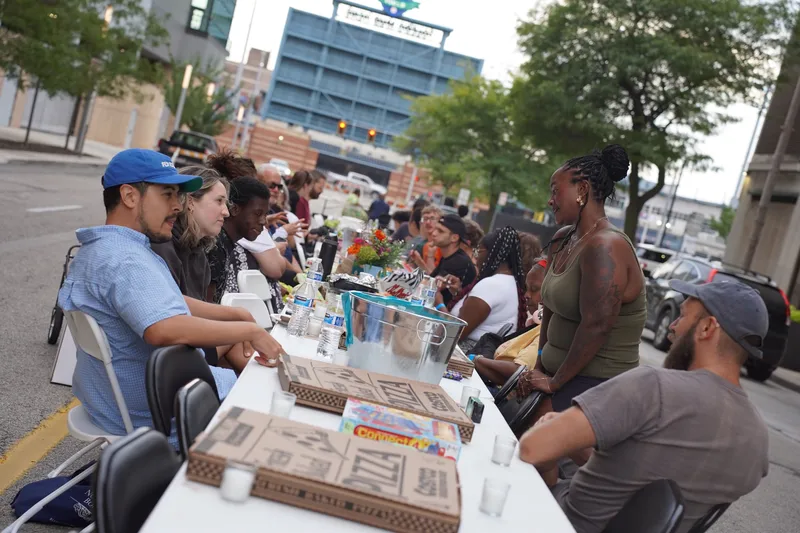
I got an email from a guy in Toledo who shut down a street and fed 75 strangers dinner.
His name is Calvin Sweeney. He's 26. He put one long table down the middle of N. Superior Street in downtown Toledo, filled every seat in about a week, and ended up with a waitlist of more than 100 people.
Out of pocket, the whole thing cost him $75.
I didn't go. Calvin sent me a recap afterward, and then he very patiently answered a pile of nosy questions about permits and folding chairs and what he'd do differently. I loved all of it. So most of this article is his, in his own words, with my notes where I have something to add.
Here's the part that got me. Almost nothing he planned actually survived the night. And it worked anyway.
What Street Supper was
One table. One closed street. Seventy-five people who mostly did not know each other.
Calvin runs a project called Connect More, and Street Supper was its first experiment. He describes the idea behind it like this:
The idea grew out of Connect More, a project I'm building around a simple question: What happens when we give people better reasons to show up, something worth experiencing together and enough permission to participate?
Guests brought their own dinner or takeout. There was shared pizza. People could come alone or bring somebody. That's the whole format.
And it sold out in a week.
The permit was free. The neighbors were the actual work.
This is the part everyone assumes will be impossible, so I asked him about it first.
I applied for a special events permit through my city's event website. There was no cost associated with either the application or street closure. The process took roughly a week.
Free, and about a week. That surprised me.
But the permit wasn't the hard part:
The biggest step was getting approval from the businesses on the block. Because I was closing a street with active businesses, I needed at least 75% of them to sign off on the closure.
So the real work was knocking on doors and asking people to say yes. Which is a very different task than filling out a form, and it's the one I'd budget the most time for.
Pro tip: Call your city before you assume this is out of reach. Search your city's name plus "special event permit" and read the actual requirements. Most people never check. The rules are usually posted, the fee is often small or zero, and the sign-off threshold from neighboring businesses or residents is the thing that will decide your timeline.
If a street closure sounds like too much for a first try, skip it. A driveway, a yard, a courtyard or a cul-de-sac needs no permission from anybody.
What it cost
Calvin spent $75 of his own money. Here's how that's possible:
The tables and chairs were donated by a local bar on the street and a church in the neighborhood. The food and disposable cameras were donated as well. A lot of people reached out wanting to help once they heard about the idea.
If you counted the donated stuff at full value, he estimates the night was worth $400 to $500.
I've been saying for years that hosting takes almost no money. Each party should cost you less than $100. And most people spend the most money on decorations and fancy appetizers that really don't matter.
Calvin came in under that, outdoors, for 75 people. The reason is that he asked. People want to be part of something like this, and a folding table is an easy yes.
Here's what he actually bought with the $75, and this is the good part:
Most of what I actually purchased were things like tablecloths, candles, kraft paper runners and crayons. Ironically, some of the things we ended up barely using.
The invitation was one Instagram Reel
No email list. No ticketing platform. One video.
I primarily promoted it through an Instagram Reel. I felt Instagram gave it the best opportunity to spread organically outside of TikTok, and it ended up reaching more than 10,000 views with 100+ shares.
More than 10,000 views. One hundred shares. Seventy-five seats gone in a week.
Here's what the offer actually was:
I was shutting down a street and inviting 75 strangers to have dinner together. People could bring dinner or takeout, there would be some shared pizza, and they could come alone or bring someone with them.
That tells you what's happening, what to bring, and that you're allowed to show up by yourself. That last part does a lot of quiet work. Coming alone to a dinner with strangers feels risky, and saying "you can come alone" out loud removes the risk.
But the video itself is the part worth studying. I asked Calvin for the script and he sent the whole thing, visual cues and all. It isn't a polite announcement. It's a bit.
He opens standing in the middle of the street he's trying to close:
I'm trying to shut down a street in downtown Toledo and invite 75 strangers to dinner.
Then he jump cuts to a tighter shot and undercuts himself:
Which is apparently more complicated than just asking nicely.
Then he gets sincere, and this is the actual reason people signed up:
I live downtown, and I keep thinking about how many of us live right beside each other without actually knowing each other.
And then my favorite thing in the whole video. He cuts to himself waving at an empty sidewalk:
So far, the neighborhood response has been overwhelming.
He holds the shot half a second too long. Cricket sounds. Then:
Mostly because no one is currently here.
He's telling you that nobody has signed up yet, on camera, in the video asking you to sign up.
I think that's why it worked. The number one fear for a new host is that nobody is going to show up. Calvin took that exact fear, put it in the ad on purpose, and made it the reason to join him. You're not RSVPing to an event. You're saving a guy standing alone on a street.
He follows it with a run of everything he's juggling:
I'm inviting strangers. I'm figuring out tables. I'm coordinating the street closure. I'm planning everything that actually goes on the table. And I'm checking the RSVP list an emotionally unhealthy amount.
Then he ends with the date and one instruction:
Street Supper is happening September 13 in downtown Toledo. Follow along to see whether I can actually turn this street into one long table.
Here's the whole thing:
Pro tip: Steal the structure, not the jokes. Say the thing you're doing in one sentence. Admit the part that's going badly. Say why you actually care. Give a date and one instruction. Calvin's version is funny because he's funny, and a straight version of those four beats works fine.
Pro tip: If you get a response like Calvin's, you'll need somewhere to put the overflow. He ended up with a waitlist of more than 100 people, and he wasn't kidding about refreshing it. I use Mixily for this, because it handles RSVPs and a waitlist without making guests download anything or make an account.
What went wrong
Plenty. He was refreshingly honest about it:
Strong winds ripped the kraft-paper table runner, prevented tablecloths from staying in place and later made the planned candle-lighting moment impossible. There were also issues with the sound system.
The wind took out the decorations he'd paid for and killed the one big scripted moment of the evening.
What I find useful is his diagnosis, because it isn't "I got unlucky":
I live on the street I closed, so I assumed I knew the space well. I didn't think enough about things like wind, access to working outlets or how the setup would perform once everything was actually in place. Next time I'd do a more formal walkthrough specifically looking for those kinds of issues.
He knew the street. He just knew it as a person who lives there, not as a person about to put 75 chairs on it.
Warning: Walk your space the week before, with your actual setup in mind. Where does the wind come from. Which outlets work. Where does the sun sit at your start time. Where do people put trash. You will find three problems, and finding them on a Tuesday is free.
Grab the free 2-page party checklist.
The $70 of games nobody played
This one is my favorite, because Calvin paid for the lesson twice.
The night before Street Supper he hosted a game night:
I spent $70+ on games, and most of the night people either played games someone else brought or just talked.
He spent more on games for the small event than he spent on the entire street dinner.
Then the same thing happened at Street Supper. He'd prepared conversation prompts and planned games. He'd even advertised them in the Reel, "random little games people can pick up while they eat." People mostly ignored them and talked to each other instead.
Now, I'm not a no-structure guy. I run something at my own events that I call compress and release. Compression is the structured part, where I'm leading and facilitating and nobody else is talking. Release is the unstructured time right after it. As you compress, that want for conversation builds up, and when you release it you get a lot more conversation than unstructured time would have given you on its own. It's why a room comes alive right after a talk.
So here's what I think happened at Street Supper, and it's not that structure failed.
Two guests asked if they could run a game of musical chairs. Within minutes about 25 adults were playing in the middle of the street while everybody else watched and laughed.
That's a compression. It's exactly the beat Calvin planned for and couldn't force. It just came from the guests instead of from him.
The part he didn't plan
The first guests showed up carrying their own tablecloths, flowers and desserts. A group brought wine and glasses and poured for people they'd met ten minutes earlier. All night, people kept adding things to the table: flowers, candy, salads, more dessert.
Then they started running the thing.
Guests took photos so Calvin could sit down and eat. They cleared trash. They checked on his volunteers. After he told everyone they were free to go, a group stayed behind to fold chairs and carry tables.
Calvin's takeaway:
That ended up being the biggest takeaway from the first Street Supper. I spent weeks trying to design ways for people to interact, but the night worked best when people felt enough ownership to create the experience themselves.
I thought I was building a dinner for people to attend. By the end of the night, it felt much more like everyone had built the dinner together.
I want to be careful here, because "just let it happen" is bad advice. Calvin didn't let it happen. He spent a week getting businesses to sign off. He got tables donated. He made the video. He put 75 chairs on a street.
What he didn't do was fill every minute. He built the container and left room in it. That's a different thing from winging it.
How to do this on your own street
I asked him for the 20-person version, the one somebody could pull off on a residential block without a permit. His answer:
At its simplest: a couple of tables, somewhere for people to sit, food and an invitation. You could even ask guests to bring their own chairs, food and drinks. The people attending can create a lot of the experience themselves.
And what to skip:
I would skip buying a bunch of games, elaborate decorations or trying to program every part of the night. Give people a reason to gather and a space that makes conversation comfortable. That's really the core of it.
Here's how I'd run it:
- Pick the date first. Before you check a single rule, open your calendar and pick a date three to four weeks out. Everything else is easier once the date is real.
- Check your city's special event permit page. Or skip the street entirely and use a driveway, yard or cul-de-sac.
- Ask the neighbors early. If you need sign-off from businesses or residents, start there. It's the longest lead time in the whole project.
- Borrow the tables and chairs. A church, a bar, a school, a neighbor with a garage. Ask three places, you'll get one yes.
- Make one invitation and say the awkward part out loud. Tell people what to bring, and tell them they can come alone.
- Walk the space a week ahead looking for wind, outlets, sun and trash.
- Buy less than you think. Calvin's $75 went mostly to things the wind destroyed and nobody missed.
Pro tip: Get name tags. It's the one thing I'd add to Calvin's list, and it costs about seven dollars. Seventy-five strangers at one table will spend the first hour not asking each other's names. Write them by hand as people arrive, first name only, in big block letters. Here's why name tags matter so much at a party.
FAQ
Do I need a permit to close my street for a block party?
Usually yes, and it's often free. Calvin got a special events permit through his city's event website at no cost, and the process took about a week. Requirements vary a lot by city, so search your city's name plus "special event permit." If you're closing a street with businesses on it, expect to need sign-off from a share of them. Calvin needed 75%.
How much does a block party cost?
Calvin spent $75 out of pocket for 75 guests. The tables, chairs, food and disposable cameras were all donated by a local bar and a neighborhood church. Counting donations at full value, he estimates the event was worth $400 to $500. Ask before you buy. Most of what he paid for was decoration that the wind destroyed.
What should guests bring to a block party?
Calvin asked people to bring their own dinner or takeout, and he provided shared pizza. Guests went further on their own and brought tablecloths, flowers, wine, glasses, salads and desserts. If you tell people the table is theirs to fill, they will fill it. For a longer list of what to bring as a guest, read our guide to what to bring to a house party.
How far in advance should you plan a block party?
Calvin's whole timeline was about a week for the permit, and his 75 seats filled in a week after one Instagram Reel. Give yourself three weeks if you need approval from neighboring businesses, since that's the slowest step.
Go do it
Calvin closed a street for $75 and the best part of the night was the part he didn't plan.
You probably don't need a street. You need a table, a date, and an invitation that tells people they can come alone.
If you host one, send me a photo. I read every email, and a picture of a long table full of people who just met is my favorite thing to get.
Calvin Sweeney is the creator of Street Supper and the person behind Connect More. Photos courtesy of Calvin Sweeney.