Starting a new job is exciting. But it can also feel lonely, especially those first few weeks when you don't know anyone yet.
How do you actually make friends at work? Not just friendly acquaintances, but real connections with people you look forward to seeing?
I've written a book called The 2-Hour Cocktail Party about how to host small gatherings that create genuine friendships. And I've found that the same principles that work at a party work just as well in a workplace. You just have to be a little more intentional about it.
In this article, you'll learn:
- Brian Kutsch's creative flier experiment at Apptegy
- Six tactics I recommend for making friends at a new job
- The "three invitations" rule that changed how I approach new relationships
- Why hosting a small work gathering is the fastest path to real friendships
Brian Kutsch's Flier Experiment
This is Brian Kutsch. He just started working at Apptegy, an education technology company in Little Rock, Arkansas.
Brian wanted to make new friends at work. So he did something creative: he made fliers and placed them around the office.
This is what it looked like:
Here's a closer look at the sign:
Brian's brilliant idea of adding a QR code for his social media accounts.
The QR code links to Brian's social media handles, as well as his resume and a charity he supports.
Brian told me there were two things he intentionally built into the sign:
- The QR code points to his social media profiles. His company's culture encourages employees to connect digitally as well as face to face.
- The flier uses a meme format with brief, direct text. It's a quick read that's also a little funny.
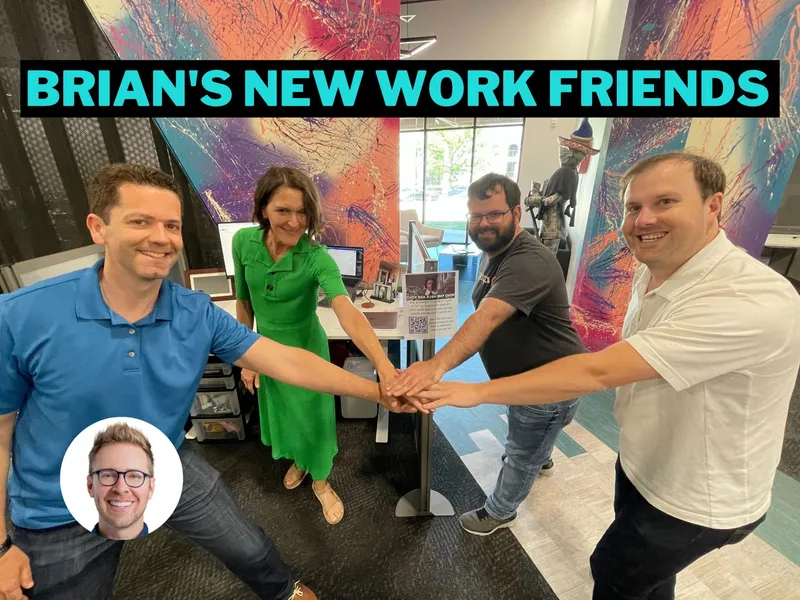
Brian and his friends at work with his flier!
I asked Brian how it went. What were his goals?
"In an office with so many co-workers, it's hard to remember everyone's names let alone make sure that you even get a chance to meet everyone. My hope... was that by following each other on social media, maybe we would learn more about families, hobbies, pastimes, accomplishments, etc. Not only would names start to stick a little better, but it would help us get to know one another on a more personal level."
Was it a success?
"It certainly got some attention! I did meet some new people, but not as many as I hoped."
Brian and his new friends at work.
Why didn't more people respond?
"Since I'm so new in the office, I was a little wary about these posters being perceived as a 'look at me' attention grab. This experiment was such a unique method of communication that was so highly visible... The signs were placed in moderately conspicuous locations (right near my cubicle) that weren't necessarily going to grab everyone's attention. That resulted in the sign being less effective. But it ensured that the intention seemed genuinely good natured."
If you want to try Brian's approach, put the signs in more prominent spots. The break room, the bathroom, near the coffee machine. Then send me an email and tell me how it goes.
Brian and his work friend, shaking hands.
Brian looks cool in his workstation. Thumbs up for new experiments!
Six Tactics to Make Friends at a New Job
Brian's flier approach is creative. But there are also simpler things you can do. These are the tactics I'd recommend to anyone starting at a new company.
1. Host a small gathering after work
This is the one I believe in most. You don't need to throw a big party. Invite four or five coworkers for drinks on a Thursday evening. A low-key bar, a 90-minute window, nothing fancy.
The reason this works so well is that it gets people out of work mode. You see each other as full human beings, not just coworkers. And the person who hosts gets a reputation as a connector right away.
I've seen this happen over and over. The new hire who throws a small happy hour in month one becomes the person everyone knows and likes by month three.
Pro tip: Keep the first gathering small. Four to six people is ideal. A big group is harder to plan and the conversations stay surface-level. Small groups go deeper faster.
2. Use nametags at company events
I know. Nametags feel corporate and a little awkward. But they work.
When I wrote my book, I interviewed hundreds of people about how they make friends. The single most common barrier was not knowing someone's name after meeting them. Nametags solve that instantly.
If you're organizing a company event or even a team lunch, bring nametags. People will tease you for it. Then they'll secretly love it. And they'll remember your name.
3. Bring food as a conversation starter
Food gets people talking. Bring donuts on a Friday morning. Leave a bowl of candy on your desk. Bring something from a bakery near your home and mention where it's from.
Food creates a reason for people to stop by and chat. It gives you something to talk about. And it signals that you're the kind of person who thinks about other people. That's how friendships start.
4. Start a lunch group or walking club
This one takes about five minutes to set up. Send a message on Slack or email: "I'm grabbing lunch at noon if anyone wants to join." Do it three times and you have a lunch group.
A walking club works the same way. "I'm going for a 20-minute walk at 2pm. Anyone in?" It sounds small but these recurring touchpoints are how real friendships develop. You see the same people over and over and the relationship builds naturally.
5. Use icebreaker questions in team settings
Most team meetings start with work immediately. But if you're leading a meeting or have any say in the format, try opening with a quick icebreaker question.
Something like: "What's one thing you did this weekend that had nothing to do with work?" Or: "What's a skill you have that most people here don't know about?"
These questions take two minutes and they change how the room feels. People go from colleagues to actual people with lives and interests. I have a whole list of questions that work well for this on my icebreaker questions page. Most of them work just as well in a work setting as they do at a party.
6. Follow the three invitations rule
Here's something I tell everyone who asks about making friends: don't give up after one or two attempts.
People are busy. They decline invitations not because they don't like you, but because the timing was bad. Someone cancels on your happy hour because their kid was sick. Another person skips the lunch because they had a deadline. That doesn't mean they're not interested.
My rule: invite someone three times before you decide they're not interested. Three genuine attempts. If all three get turned down without any counter-offer, maybe they're just not a good fit. But most of the time, by the second or third try, the timing clicks.
Pro tip: When someone declines, say "No worries, maybe next time." Then actually follow up a few weeks later. That follow-up is what separates people who make friends from people who wonder why they can't.
Grab the free 2-page party checklist.
The Bigger Idea: The Office Is Just Another Venue
I think people overcomplicate this. They wait for the company to create connection opportunities. They wait for someone else to invite them. They assume work friendships will develop on their own.
They usually don't.
Friendships at work form the same way friendships form anywhere: through repeated contact, in low-pressure settings, with people who share some common ground. Your job gives you all three of those things. You just have to take the first step.
Brian's flier was a first step. It was creative and a little funny and it signaled that he wanted to know people. That's all it takes. You don't have to make a flier. But do something intentional in your first few months.
Host a small happy hour. Bring donuts. Ask a real question in a team meeting. Invite someone to lunch twice.
The tactics matter less than the intention. Show people you want to know them. That's the whole thing.
Conclusion
Making friends at work isn't about being the most outgoing person in the room. It's about being deliberate when most people are passive.
Here's a quick summary of what works:
- Host a small after-work gathering. Four to six people, low-key spot, 90 minutes.
- Use nametags at company events. People will thank you later.
- Bring food. It creates a natural reason to talk.
- Start a lunch or walking group. Recurring contact builds real friendships.
- Ask icebreaker questions. They take two minutes and change everything.
- Try three times before giving up. Most people aren't saying no, they're just busy.
If you want to go deeper on hosting small gatherings that build friendships, check out my book. It's full of specific scripts, formats, and ideas you can use right away.
You can also use fliers to make friends in your neighborhood. See what Sujan Patel did to make new family friends. Or check out what I did to put up fliers and meet new friends in New York City.
Have you tried any of these? Email me and let me know what worked.