I've hosted more parties than I can count, and camp is really just a party that lasts a whole weekend.
Adult summer camp takes everything that makes a good gathering work, name tags, a packed schedule, strangers who become friends by Sunday, and stretches it over three or four days instead of three or four hours. You get archery and canoe races and color wars, but also craft beer, sunrise yoga, and a rule that phones stay in a bin so you actually talk to the people around the fire.
In this article, you'll learn:
- What actually separates a great adult camp from an awkward one, from a hosting point of view
- Five adult summer camps I checked are still running and taking bookings
- A real breakdown of camp activities, by type
- What to know if you're looking at camp in your 40s, 50s, or beyond
- How to pick the right camp for you, and what to pack
What Actually Makes an Adult Camp Good
Here's the thing about camp. The lake and the climbing wall are not really the product. The real product is a room full of strangers turning into people you actually want to stay in touch with. That only happens if the camp is structured well.
I think about this the same way I think about hosting any gathering. The activities matter less than the mechanics of how strangers get introduced to each other.
The best camps borrow a trick I lean on at every party I host: something visual that shows who's who. Usually that's a name tag, a colored wristband, or a cabin assignment. It sounds small. It isn't.
"I've found that a name tag serves almost like a sports jersey that it's like a visual unifier that tells you that this is not a party of cliques. And what I don't want happening at my parties is for all my nerdy friends to talk about AI together and all my neighborhood friends to talk about parenting together and then all my swim group friends to talk about swimming. I want there to be a lot of mixing. Name tags help to kind of unify the whole group that we're on the same team and to be a visual indicator that this is a safe space to go up and say hi to somebody new."
That's why the camps with cabin assignments and small-group activities tend to beat the ones that just turn everyone loose on a big property. Mixing has to be built into the schedule, or the friend groups people arrived with just calcify.
The other thing a good camp does is run some version of introductions early. I call them rounds of intros instead of icebreakers, because the word icebreaker makes people cringe before they even show up.
"You do those intros because, number one, it helps create new conversations. Number two, when you run the intros, it actually helps people end the existing conversations they were having... And number three is we do those because it kind of gives everybody in the room a chance to do a roll call, to say where they are, who they are, to give you an idea of, like, oh, I really want to talk to that person before I leave."
A camp that skips this and just hands you a schedule of activities is betting that shared archery will do the social work for you. Sometimes it does. Most of the time it doesn't, and you end up eating dinner with the same three people you met on the bus.
I've always loved the research behind this. A sociologist named Mark Granovetter studied why new opportunities and new friendships show up in someone's life. He found they almost never come from your closest friends. They come from what he called weak ties, the people you know a little instead of a lot.
That's basically the entire pitch for adult camp. You show up knowing nobody. You leave with 40 new weak ties, a few of whom become real friends. The camp's job is to engineer as many of those first connections as it can in three days.
I also believe a good camp gives you full permission to be a little ridiculous. For my 40th birthday, I rented out one of the country's largest indoor water parks, north of Austin, for about 40 of my friends. We rode water slides all morning. I'm not as young as I used to be, and I was sore for two days afterward from running up and down those stairs. It was one of the best parties I've ever thrown, because nobody there was checking their phone or worrying about looking cool. That's the whole appeal of camp, too. It's a weekend where being a grown-up is optional.
Who Adult Summer Camps Are For
- Solo travelers who want to meet people without the small-talk pressure of a typical group tour
- Couples who want a playful reset instead of another resort weekend
- Friend groups and bachelor or bachelorette parties who'd rather kayak and karaoke than bar-hop
- Remote workers and people new to a city who want a fast way to build a group of local-ish friends
- Anyone who wants to swap a weekend of scrolling for a weekend of doing something with their hands
What a Weekend at Camp Actually Looks Like
Most adult camps run Friday to Sunday or Friday to Monday. You get assigned a cabin or bunk when you check in, and that's usually your first mixing point since you didn't pick your bunkmates.
Mornings tend to have optional electives: sunrise swim, yoga, a coffee walk. Afternoons are when the classic camp stuff happens, ropes courses, archery, capture the flag, color wars between cabins. Evenings shift into dinner, a themed party or talent show, and a no-phones campfire.
The golden rule at almost every camp is that everything is optional. Nobody is going to make you do the trust fall.
Pro tip: Book with at least one friend if you're nervous about going solo, but don't sit together at every meal. The whole value of camp is talking to people outside your existing circle. You can debrief with your friend on the drive home.
Summer Camp for Adults Over 40 and Over 50
This is one of the most common questions people search before booking, and it deserves a straight answer instead of a line buried in an FAQ.
Almost every general-audience adult camp, Camp No Counselors, Club Getaway, Camp Yampire, skews toward the mid-20s to mid-40s crowd, but none of them cap attendance by age. Camps report regulars well into their 50s and 60s. If you're over 40 and worried about being the oldest person there, you almost certainly won't be.
That said, if you'd rather be around people closer to your own life stage, a few things help:
- Women-only camps tend to skew older on average. Camp Social, listed below, says its oldest camper has been 86, and its sessions are open to women of any age.
- Wellness-focused camps run older than party-focused camps. A weekend built around yoga, hiking, and quiet time draws a different crowd than one built around an open bar and a DJ.
- Ask before you book. Most camps will tell you the typical age range of a past session if you email them. It's a two-minute question that saves you from guessing.
If nostalgia is the whole point for you, that cuts both ways. A camp built around 90s throwback nights or classic sleepaway-camp games works at any age. Nobody card-checks your nostalgia.
Adult Camp Activities, By Type
"What do you actually do at adult summer camp" is one of the most-searched questions on this topic, and most camp websites bury the answer in a photo gallery. Here's what actually shows up on a typical schedule, grouped by type.
Classic camp sports Archery, canoe and kayak races, ropes courses, ziplining, disc golf, pickleball, and capture the flag. This is the backbone of almost every camp's daytime schedule.
Water activities Lake swimming, paddleboarding, waterslides, and the occasional polar plunge for the brave. If a camp is on a lake, expect at least half a day built around it.
Structured social games Color wars (teams competing across the whole weekend), scavenger hunts, trivia, two truths and a lie, and talent shows. These exist specifically to force mixing between people who don't already know each other.
Wellness and quiet activities Sunrise yoga, meditation, guided hikes, journaling, and silent hours for camps with a digital-detox angle. These are usually optional and run alongside the louder stuff, not instead of it.
Creative workshops Tie-dye, pottery, silkscreening, songwriting, and improv. Most camps run two or three of these across a weekend as electives.
Evening programming Campfires, themed parties (90s night is a recurring favorite), silent disco, live music, and s'mores. This is where the day's activities turn into actual friendships, since nobody is rushing off to the next station.
Five Adult Summer Camps I Checked Are Still Running
I checked every camp below directly before including it. Each one has a working website and an active booking flow as of this writing.
Camp No Counselors (Nationwide)
A three-night, all-inclusive weekend run at real summer camps in New York, California, Texas, and Florida. Daytime is classic camp activities, camp olympics, lake days. Nights are themed parties with an open bar. Their unofficial motto is "don't be the asshole," which tells you the vibe: welcoming, loud, and built for solo travelers and groups alike.
Club Getaway (Kent, Connecticut)
A lakeside camp in the Berkshires, about 90 minutes from New York City, with more than 80 activities: ziplining, wakeboarding, an aerial park, and dance parties. Club Getaway runs a full slate of weekend trips through the season rather than one big annual event, so there are usually several dates to choose from.
Camp Social (Equinunk, Pennsylvania)
A women-only, three-day, two-night camp in the Poconos that brings together more than 300 women, most of whom arrive solo. The schedule mixes classic camp stuff, archery, tie-dye, a ropes course, with wellness programming like yoga and lake dips. It's all-inclusive, including a swag bag, and runs sessions in early summer and late summer.
Camp WILD (Parham, Ontario, Canada)
A women's wellness retreat (open to cis and trans women 18 and up) at a lakeside camp in Ontario, built around a choose-your-own-adventure schedule rather than a fixed itinerary. It leans further into unplugging and reconnecting with yourself than the party-camp end of this list, and runs a handful of sessions a year.
Camp Yampire (Virtual and in-person)
Started in 2020 to fight pandemic isolation, Camp Yampire is still running and still free. It's mostly virtual, Zoom happy hours, remote trivia, dance parties, but has added in-person events too. If cost or travel is the barrier keeping you from trying camp, this is the lowest-risk way to see if the format is for you.
Grab the free 2-page party checklist.
How to Choose the Right Camp for You
- Ask yourself what you actually want. Connection, creativity, adventure, or quiet. Most camps lean hard into one of those.
- Weigh location against vibe. A camp three hours away that fits you perfectly beats one down the street that doesn't.
- Decide solo versus group. Going solo pushes you to meet more people. Going with a friend gives you a safety net.
- Check the length. A weekend is a much smaller commitment than a full week, and a good first step if you've never done this before.
- Check the policy on alcohol. Some camps run on an open bar. Others are dry and wellness-focused. Pick the one that matches what you're actually looking for.
What to Pack for Adult Summer Camp
- Essentials: a sleeping bag or bedding if it's not provided, a flashlight, bug spray, and comfortable clothes you don't mind getting dirty
- Optional but worth it: a costume for theme nights, a disposable or Polaroid camera, and a battery pack if the camp allows phones
- Mindset: come ready to be a little ridiculous. That's the whole point.
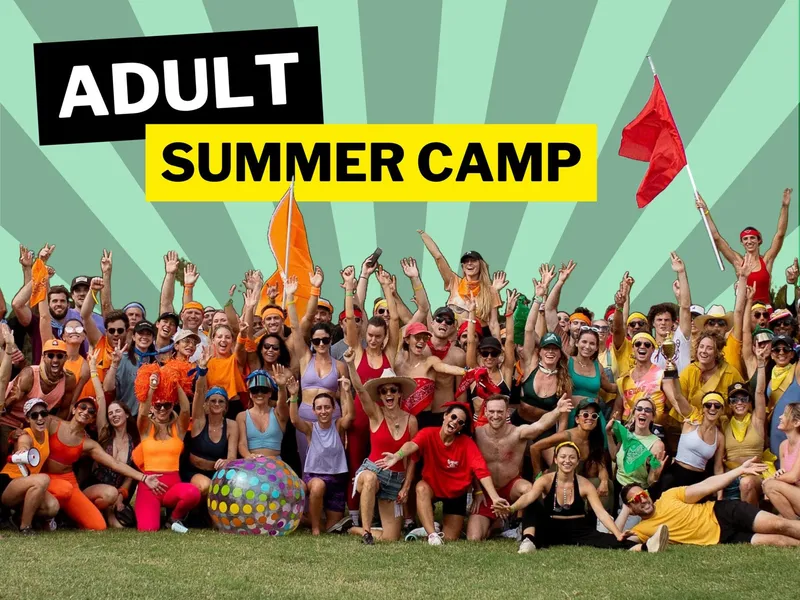
Photos From Adult Summer Camps
Frequently Asked Questions
Is there an age limit for adult summer camp?
Most camps set a minimum age around 21, since many serve alcohol. A handful of wellness-focused retreats set the minimum a bit higher. There's rarely a maximum. Camp Social, for example, says its oldest camper has been 86.
Are phones allowed at adult summer camp?
It depends on the camp. Some lock devices away at check-in. Others just discourage phone use during group activities and let you use your own judgment. If it matters to you, check the camp's policy before you book, and pack a battery pack just in case.
What if I go by myself?
Solo campers are the norm, not the exception. Camp Social reports that about 99% of its attendees arrive solo. Most camps build in bunk assignments and rounds of intros specifically so solo travelers aren't left to fend for themselves.
Will I be the oldest person there?
Probably not. The typical range at most general camps is mid-20s to mid-40s, but regulars in their 50s and 60s are common, especially at wellness-focused and women-only camps.
How much does adult summer camp cost?
It varies a lot by camp and length of stay. A three-day, all-inclusive weekend typically runs somewhere around $700 to $1,200, covering meals, activities, and a bunk. Day camps and virtual camps like Camp Yampire can cost nothing at all.
What's the difference between a party camp and a wellness camp?
A party camp is built around games, open bars, and themed nights, closer to a bachelor or bachelorette weekend with a lake attached. A wellness camp is built around yoga, quiet time, and workshops, with the social structure still there but turned down a notch. Read the activity list on a camp's site before booking. It'll tell you which one you're getting.
Can I bring a friend, or do I have to go alone?
Either works. Most camps welcome friend groups and couples as easily as solo travelers. If you're nervous about going alone, one friend is plenty. Just don't spend the whole weekend only talking to them.
Conclusion
Adult summer camp works because it takes the best part of a good party, strangers turning into friends, and gives it three full days to happen instead of three hours.
The camps that do it well use the same tools I use at every gathering I host: something that shows who's who, structured ways to meet people early, and a schedule that keeps forcing you into new groups instead of letting cliques form. Pick a camp that matches what you actually want, whether that's an open bar and color wars or a quiet lake and a yoga mat, and go in ready to be a little ridiculous.
If you want to build that same kind of connection at home instead of a lake in the woods, grab a copy of my book and start hosting your own version of camp.