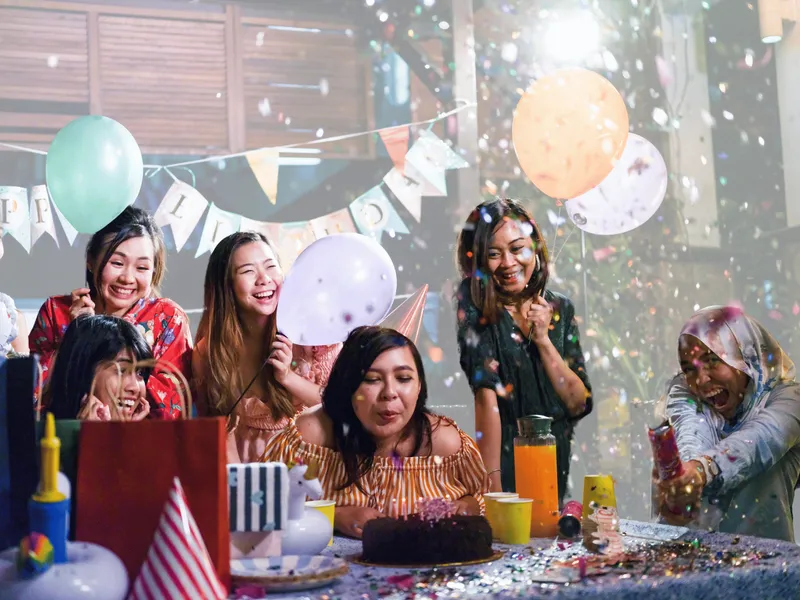
I built my hosting method around one idea. A party needs a program, not just an invitation. When nobody's planned what actually happens once guests arrive, people mill around and wait for someone else to get things started.
A birthday party program is really just an order of events. What happens, and roughly when. It's not a script you read out loud. It's a plan in your head, so you're never standing in your own kitchen wondering what comes next while your guests watch.
Below is the exact one I use for adult birthday parties, plus shorter versions for kids, teens, milestone birthdays, and surprise parties. Use it as a template. Adjust the times to your own start, but keep the order.
The Birthday Party Program for Adults
This is the format I use for adult cocktail-style birthday parties: name tags at the door, a couple of rounds of icebreakers, drinks instead of a sit-down dinner, and a hard stop at two hours.
It works because your guests don't all know each other. Skip a program like this at a family reunion, where every parent already knows every other parent. Use it when you're bringing together friends, coworkers, and neighbors who need an actual reason to talk to each other.
Before the program even starts, lock down your RSVPs. A platform like Mixily makes it a lot easier to know who's actually coming, instead of guessing at headcount the morning of. Send three reminder messages in the days leading up to the party. That sounds like a lot, but no one has ever told me they got spammed too much about a free party they're invited to.
Set your own start time using my guide to the best time to start a party, then build the rest of this order of events around it. Here's the version built around a 7:00 p.m. start:
- 6:30 p.m., 30 minutes before: Drinks and food out, music on low, name tags ready at the door.
- 7:00 p.m., doors open: Greet every guest yourself. Hand them a drink and point them toward the group.
- 7:30 p.m., first icebreaker: Once most of your guests are in the room, gather everyone for a quick round of names and a low-stakes question.
- 8:00 p.m., cake and a toast: The birthday moment happens mid-party, not at the end, while the room still has energy.
- 8:10 p.m., group photo: Grab it right when you've gathered everyone for that icebreaker circle, before people scatter again.
- 8:30 p.m., second icebreaker: A slightly deeper question now that the room has warmed up.
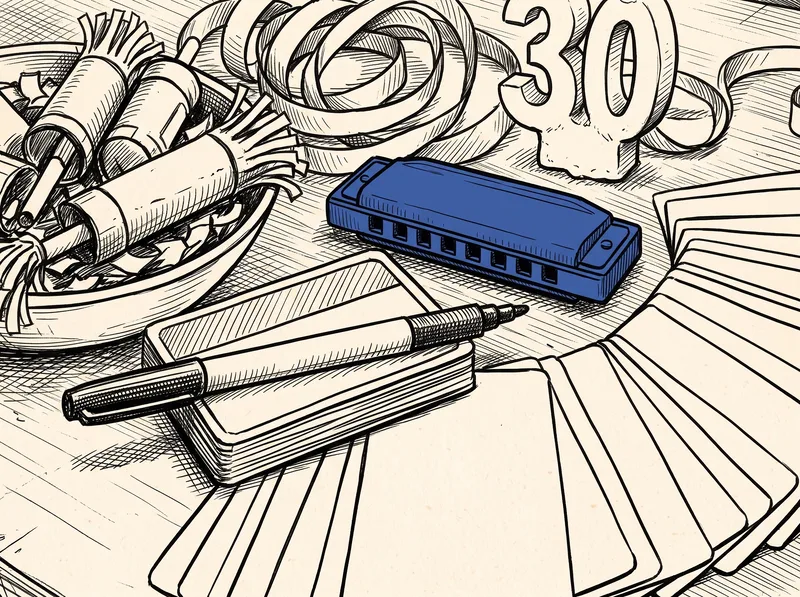
- 8:45 p.m., wind-down signal: I use a harmonica. More on that below.
- 9:00 p.m., party ends: Lights up, music down, genuine goodbyes.
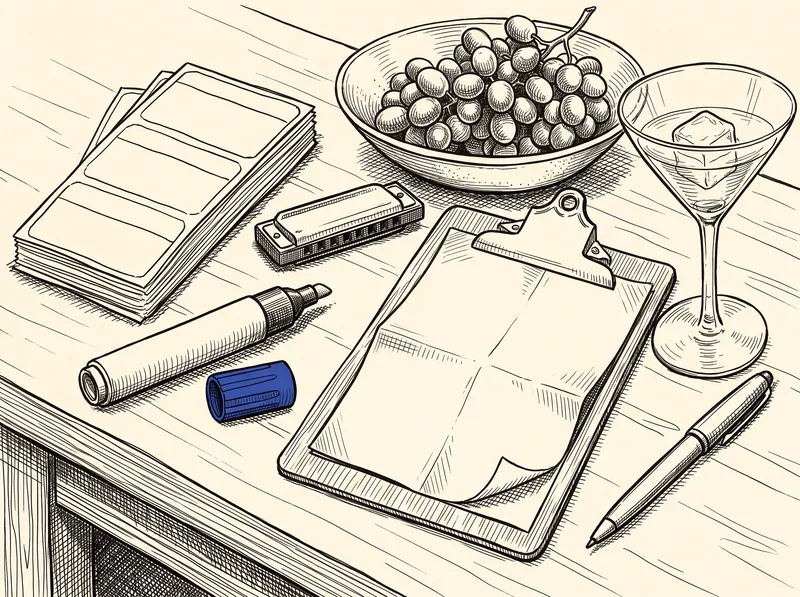
Set up before guests arrive. Ice in the bucket, food out, music at background level. Name tags with a quick icebreaker prompt at the door do more for a mixed group than almost anything else you can set up in 30 minutes.
Be an active host, not a passive one. Track who's talking to whom. Tap people on the shoulder and introduce them to someone new. I stress about the room so my guests don't have to. That's the whole job during the middle of the party.
Run two icebreakers, not one. My go-to opener asks everyone's name and their favorite breakfast food. It sounds silly, but everyone has an answer, nobody feels put on the spot, and it breaks the ice fast. For the second round, ask something people can build on: a book, show, or podcast they'd recommend.
Cake goes in the middle, not the end. Do it around the one-hour mark. The room is still warm, most guests are still there, and you've got another 45 minutes of party after the moment passes.
End on time. Fifteen minutes before your scheduled end, make a quick last-call announcement: turn the music down, thank people for coming, and give conversations a natural moment to wrap up. Then, when the time actually hits, start saying real goodbyes. Ending while the party's still fun is one of the most generous things a host can do. It leaves guests wanting to come back.
Keeping the Program on Track
A program only works if you can actually run it in the room without turning into a drill sergeant. A few things I've learned about that:
- Don't overschedule it. Pick two or three anchoring moments (an icebreaker, the cake, the group photo) and let the rest breathe. Every extra thing you try to schedule is another thing that can go sideways.
- Watch the energy, not just the clock. If the room's still buzzing at the 90-minute mark, hold off on the wind-down for a few extra minutes. If it's flagging early, start moving toward the end sooner. The clock is a guide, not a rule.
- Give the birthday person their own moment, then let them go. At their own party, the guest of honor can end up feeling passed around like a prop. Give them the icebreaker where people share what they love about them, or the toasts, then let them mingle freely for the rest of the night.
The Harmonica Signal
I carry a harmonica to every party. At the 90-minute mark, I pull it out and blow one low note for three or four seconds. Nothing fancy, no song.
It works because it's calm. No whistle, no shouting over the room. People hear it, look over, and know something's about to happen. If my hosting has any legacy, it might be making the harmonica a real party tool.
You don't need a harmonica specifically. Any small, distinctive signal works. But it's the one I use, and it's never let me down.
Milestone Birthday Program (30th, 40th, 50th)
Milestone birthdays carry more history in the room, so the program should carry a little more weight too. Not a roast, not a formal toast-a-thon. Just warmth with enough structure to hold it together. The people in that room have known the birthday person for years, sometimes decades, and the party should give that history somewhere to go.
Read my full guide to 30th birthday party ideas alongside this one if you're planning a milestone celebration.
- 0:00, cocktail hour (30 minutes): Drinks, music, and a photo display or memory board people can gather around.
- 0:30, first icebreaker (10 minutes): Name and one word that describes the birthday person. Fast, warm, and it gets every friend group talking.
- 0:40, memory-sharing (20 minutes): Ask 8-10 close friends beforehand to submit a memory involving the birthday person. Read five or six aloud, or drop them in a jar to draw from.
- 1:00, mingling and food (30 minutes): Let the room breathe. This is the peak of the party.
- 1:30, toasts (10 minutes): Two or three, max, under two minutes each. Tell your toast-givers ahead of time: one specific story, then raise a glass.
- 1:40, cake and photo (20 minutes): Cake right after toasts, a group photo right after that, then let the final 20 minutes coast toward goodbyes.
Pro tip: Collect memory submissions at least a week out. A short message works: "I'm collecting one-paragraph memories about [name] for the party. A sentence or two about a moment you shared is plenty." People deliver, and the birthday person gets something real to keep.
Kids' Birthday Party Program (Ages 5-10)
Kids' parties run on a different clock than adult ones. The structure needs to be tighter and the pace needs to be faster, because you're working against nap schedules and short attention spans, not against social awkwardness.
Two hours is plenty for this age group. Anything longer and you're fighting the kids themselves, not the program.
- 0:00, arrival and free play (20 min): Have an activity already going so early arrivals have something to do.
- 0:20, group game (25 min): Musical chairs, a relay race, or a scavenger hunt. One activity, clearly explained, energetic.
- 0:45, cake (15 min): Sing, blow out candles, serve cake while kids are still at the table.
- 1:00, presents (20 min): Open gifts while everyone eats. Have one child hand them out one at a time to keep it moving.
- 1:20, favors and low-key activity (20 min): Stickers or a simple craft while parents start arriving for pickup.
- 2:00, party ends. A firm end time is a gift to every parent in the room.
Pro tip: Assign one adult per activity zone: one for crafts, one for games, one for food. It turns chaos into a system.
Grab the free 2-page party checklist.
Teen Birthday Party Program (Ages 13-17)
Teens are a different kind of challenge than either kids or adults. They don't want to be told what to do, and they'll push back on anything that feels like an activity for children. But without any structure, the party drifts and someone ends up staring at their phone in a corner.
Give them more open time than a kids' party, but still anchor it with two or three moments that give the night some shape. 2.5 hours works well: long enough to feel like a real event, short enough that parents are comfortable with the logistics.
- 0:00, arrival (20 min): Music on, food out. Let people settle in with who they already know.
- 0:20, structured activity (40 min): Something competitive with mixed teams: trivia about the birthday person, a video game tournament, or a scavenger hunt.
- 1:00, food and free time (30 min): Let them eat and talk. Don't fill every minute.
- 1:30, cake (15 min): Same rule as the adult program. Do it before the energy drops.
- 1:45, free time or a second activity (30 min): Let the energy ride, or have a backup ready if it needs a boost.
- 2:30, party ends. Parents arrive for pickup. Most teens appreciate a clear end time, even if they'd never say so.
Surprise Party Timing
A surprise party runs two schedules at once: one for the guests, one for whoever's bringing the birthday person. Get them out of sync and the whole thing falls apart before it starts. This is the one version of the program where the order of events matters more than anywhere else, because a single slip in timing ruins the surprise.
- Tell guests to arrive 30 minutes before the birthday person. Build in a buffer in your own head, since someone will show up late anyway.
- Put one person in charge of texting updates: "5 minutes out," then "coming up the stairs now."
- Keep early arrivals comfortable, not hidden. Music on, drinks ready, volume conversational until the signal comes.
- The moment right after the surprise matters more than the surprise itself. Get the birthday person a drink, do a quick toast, and get the music back up right away.
A Few More Activity Options
If you want another anchoring moment beyond the icebreakers and the cake, these work well at almost any birthday party:
- Trivia about the birthday person. Ask five friends to each send three questions ahead of time. That gets you 15 questions, plenty for a full round, playable in teams.
- A memory jar. Set out a jar and slips of paper. Guests write a favorite memory with the birthday person and drop it in. They read through it later, on their own.
- A photo slideshow. Photos from over the years, running quietly on a TV in the background. Nobody has to participate. People gather around it and start telling stories on their own.
Pick one, not all three. The program already has an icebreaker, cake, and a photo. One more anchoring moment is plenty.
Frequently Asked Questions
What time should a birthday party start?
For adult parties, 7:00 p.m. on a weeknight works well. Read my full guide to picking a start time for how to adjust it by age group and day of the week.
How long should a birthday party last?
Two hours for adults, and about the same for younger kids. See my guide to how long a party should last for the reasoning behind it.
How do you start a birthday party program?
Greet every guest at the door yourself. Hand them a drink, point them to the group, and once most people have arrived, gather everyone for a quick icebreaker. That first icebreaker, not the invitation, is what actually starts the party. It gets every guest talking within a few minutes instead of standing around waiting for someone else to make the first move.
When should you do the cake?
Around the one-hour mark, not at the end. The room's still warm, most guests are still there, and you get another 45 minutes of party after the moment passes. If you wait until the last 15 minutes, some guests have already left and the whole thing feels rushed.
Should you open presents at a party?
For kids, yes. It's part of the experience, and kids expect it. For adults, it depends on the size. At a big cocktail-style party, opening gifts in front of everyone can feel like a performance, so skip it. At a small, close gathering, a quick present moment can be nice. My default for adults is to open gifts privately, afterward, with a few close friends.
How many icebreakers should a birthday party have?
Two is enough for a two-hour adult party: one about 30 minutes in, one about an hour later. For milestone birthdays, add the memory-sharing moment as a second, deeper round. Any more than that and it starts to feel like a facilitated workshop instead of a party.
Keep the Program Simple
A birthday party program isn't about control. It's about giving the night a shape so you can relax into it instead of improvising the whole time.
Set a start time and an end time. Run two icebreakers instead of one. Move the cake to the middle. Then let the harmonica, or whatever your signal is, tell the room it's time to wind down.
You don't need every item on this list. Even three or four of these moves, done on purpose instead of by accident, will change how your next birthday party feels.
Good luck. Your guests will remember it.